
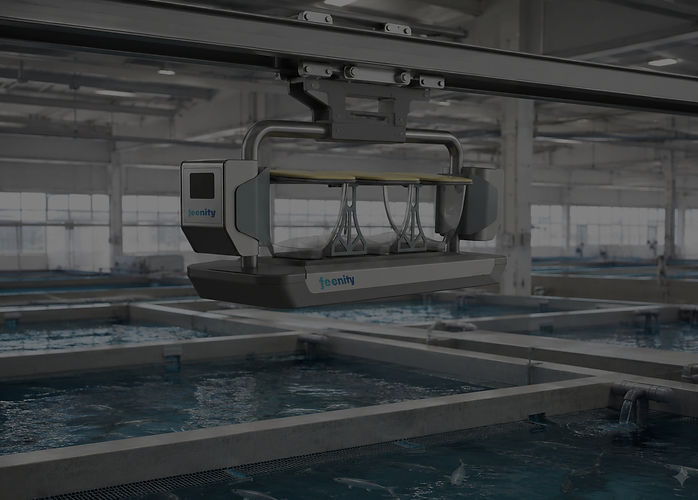
Robotic Fish Feeding System
At "Sea-Gal"
_edited_edited.png)
Designed Around the Existing Farm
The robotic system had to fit the physical layout of an operating fish farm.
CrystalVision designed the functional rail routes according to the location and height of the tanks, greenhouse structure, available clearances and obstacles along the route.
The system therefore included more than the robots themselves. Rail layout, feeding positions, charging stations, wireless communication and control software all had to be designed around the actual facility.
This allowed the robotic feeding system to become part of the farm infrastructure rather than a standalone machine placed beside it.
More Than a Decade in Daily Operation
The system operates inside a working aquaculture facility, where equipment is exposed to heat, humidity and continuous daily use.
The two original robots installed at Sea-Gal in 2013 are still operating today.
Over the years, CrystalVision has continued to maintain and update the system, including changes to the control software and feeding functions as operational requirements developed.
The long operating history also gave CrystalVision practical experience with the mechanical, electrical and software challenges involved in running autonomous feeding equipment in real aquaculture conditions.
From the Original Robots to Feenity
The original Sea-Gal robots were developed for automated dry-feed distribution.
As CrystalVision continued developing the technology, the feeding concept was expanded into a new generation of robot: Feenity.
One of the major additions was the ability to handle live feed such as Artemia.
CrystalVision had already investigated automated Artemia feeding with Sea-Gal years earlier, examining issues such as dosing, mixing, storage and cleaning. The capability was later developed as part of the Feenity platform.
In 2025, a Feenity prototype with Artemia feeding capability was installed at Sea-Gal. It currently operates on a limited part of the farm alongside the two original robots.
Sea-Gal therefore connects two generations of CrystalVision's feeding technology: the first commercial robotic feeding installation and the development of the current Feenity platform.
The Result
The Sea-Gal project replaced a labor-intensive daily feeding route with an automated process covering approximately 250 individual growing tanks.
The system combines autonomous movement, RFID-based positioning, individual feeding programs, controlled dosing, wireless communication and automatic charging.
Its value comes from the combination of these elements: hundreds of individual feeding locations can be managed from a central feeding plan while the physical feeding rounds are performed automatically.
Related Solutions
Looking to Automate Feeding Across Your Facility?
CrystalVision develops robotic feeding systems for aquaculture facilities with large numbers of tanks or ponds.
From rail layout and robotic motion to dosing, charging, control software and feeding programs, the system is engineered around the physical layout and operating requirements of the facility.
Talk to us about your feeding system!
Robotic Feeding System for an Ornamental Fish Farm
Rail-mounted robots automating daily feeding at Sea-Gal since 2013
Client: Sea-Gal Ornamental Fish Farm
Location: Moshav Idan, Israel
Application: Ornamental fish production
System: Automated rail-mounted feeding robots
Project Summary
Feeding hundreds of ornamental fish tanks is a repetitive but demanding daily task.
Different tanks may contain different species, ages and quantities of fish, requiring different feeding amounts and schedules. At Sea-Gal, approximately 250 growing tanks had to be fed several times each day.
CrystalVision developed a rail-mounted robotic feeding system to automate this process.
The first commercial installation was completed at Sea-Gal in 2013. Two independent robots were installed, each operating on its own overhead rail network. The robots automatically travel between tanks, identify each feeding location, dispense the programmed amount of feed and return to their charging stations.
The Challenge - Feeding 250
Tanks Several Times a Day
An ornamental fish farm is very different from a facility with a few large production ponds.
Each tank is a separate feeding location, and feeding requirements may vary according to fish species, age, stocking level and stage of production.
Before the robotic system was installed, Sea-Gal dedicated approximately half of one employee's working time to feeding the farm's tanks.
The task involved repeatedly moving through the facility, identifying each tank and delivering the required amount of feed several times throughout the day.
The challenge was therefore not simply to move feed from one place to another. The system had to automate the route while still allowing the grower to define how much feed each individual tank should receive.
A Rail-Mounted Robot
Above the Tanks
CrystalVision developed an overhead rail system that allows the robots to travel above the growing tanks without occupying working space on the floor.
The farm is divided between two independent robotic systems, each serving its own area.
Every feeding location is equipped with an RFID tag. As the robot travels along the rail, it identifies the tank, stops at the correct position, dispenses the programmed portion and continues to the next feeding station.
This approach allows one robot to serve a large number of tanks without installing a separate motorized feeder at every location.
Individual Feeding Programs
The grower controls the feeding program through a table containing the daily feeding quantity for each tank.
Values can be entered manually, or a complete CSV feeding table can be imported to update the entire farm at once.
The system also includes a growth-based feeding function. The operator enters an expected growth curve for a species, including changes in feeding requirements over time, and the software gradually adjusts the programmed feeding quantities accordingly.
The grower can review the feeding table at any time and modify individual tanks or groups of tanks when required.
This makes it possible to manage different feeding programs across the farm while the physical feeding rounds themselves are carried out automatically.
Autonomous Movement and Charging
Once the feeding program is defined, the robots perform their feeding routes automatically.
Each robot moves through its assigned section, identifies the RFID feeding stations and delivers the quantities defined in the feeding table.
After completing its work, the robot automatically returns to its charging station and connects to the charger.
This allows repeated feeding rounds to be carried out throughout the day without requiring a worker to walk the complete feeding route each time.